Tuesday, 23 May 2017

Tuesday, 14 February 2017
The Nature & Purpose Of Music Videos
BTEC MEDIA YEAR 12 - P1M1D1
Lucas Stone
Question: Comprehensively
explain the NATURE (How does it exist) and PURPOSE of music videos?
Music
videos date back to the early 1920’s and first started appearing on Television
around the 1980’s time when Aerial television became a thing. You used to be
able to tune into one of 5 channels and hope that one of them were broadcasting
a music video. The nature of music
videos is to visualise a representation of a song. They also allow the person
to experience emotions which they may not be able to without the video.
Q: What TV Channels exist
in the UK on TV or online streaming to broadcast music videos?
Many
TV stations in the United Kingdom broadcast music videos, this is a list of
some of them…
Kerrang
MTV
VH1
Smash
Hits
Capital
TV
More4
Heat
Classic
FM
Most
of these channels are broadcasted on a variety of platforms including Sky TV,
Netflix, Virgin Media, Amazon Prime and much more. Some of these channels
require satellite dishes and extra equipment such as Sky entertainment boxes
& broadband. The others such as Virgin Media, Amazon Prime etc. all run
through high tech fibre optic internet cables which run underground instead of
being beamed from satellites in space. All of these channels are available to
anyone which has one of the services listed above.


Q: What are the
differences between music video channels? Explain in relation between
E4/VIVA/MTV/VH1/MTV Base etc.

Channels
such as MTV compared to E4 are more mainstream in terms of how much music is
broadcasted on them for example MTV is broadcasting music 24/7 whereas E4 only
occasionally broadcast music videos. Another comparison would be how different
channels cater their content for specific genres for example I have a Sky
Television package in my home and if you navigate to the music tab in the TV
Guide
there
is 6 different MTV Channels…
·
MTV Hits
·
MTV Pop
·
MTV Rock
·
MTV Dance
·
MTV Classic
·
MTV Electronic
All
of these are different based upon their name. This is great for everyone since
some people only like to listen to Dance music and may not like other genres
such as Pop, rock, classic etc.


Q: What music video
channels exist online/internet?
There
are multiple websites online which broadcast/stream music for the whole world
to view and download. An example of a website which is home to millions of
music videos would be YouTube.
 YouTube features thousands of big artists and
independent artists on their section of the website which is called ‘YouTube
Music’. Since YouTube became a thing it has become as easy as clicking a few
buttons before you’re watching a music video. There is a company called VEVO
which is a group of people who help artists get their music video out on the world-wide
web for everyone to see, pretty much every big artist you see on YouTube
nowadays has the VEVO watermark on the thumbnail of their videos. As well as
YouTube and VEVO there are a variety of music streaming websites which feature
just the Audio of the song for example Spotify, SoundCloud & Audio Jungle.
YouTube features thousands of big artists and
independent artists on their section of the website which is called ‘YouTube
Music’. Since YouTube became a thing it has become as easy as clicking a few
buttons before you’re watching a music video. There is a company called VEVO
which is a group of people who help artists get their music video out on the world-wide
web for everyone to see, pretty much every big artist you see on YouTube
nowadays has the VEVO watermark on the thumbnail of their videos. As well as
YouTube and VEVO there are a variety of music streaming websites which feature
just the Audio of the song for example Spotify, SoundCloud & Audio Jungle.


Q: Why do music videos
exist? Why did bands in the 80’s. Duran Duran, Madonna, and Michael Jackson
make music videos? Explain
Bands
such as Duran Duran and the Jacksons were those of the first to pioneer music
videos, their aim was to invest a lot money hoping to increase sales on their
records. Seeing the song being broadcasted on Television & Radio constantly
makes the person want to go and purchase their own physical copy of the
track/album. People thought that having their own physical copy of the track
made them special when really, they have just helped to fund Mr Jacksons
plastic surgery which he had done (a lot). Although yes, you were spending
around £5 for your CD, it’s always good to have a copy since future digital
copies will make the CD’s obsolete. As time progressed we are now in 2016 and
we are not able to hit a button on our phones, payments are made instantly and
the songs digital MP3 is on your device within seconds.
Q: What were they trying
to achieve by making music videos?
By
making these music videos they were able to increase their record sales A LOT.
Most people say that they only make them so that they can make more money but I
look at it from the point of view which I personally believe that without the
video the song would not make sense since the narrative of a music track is
usually based of the video. A lot of songs make people feel emotions which they
have never before experienced in their life.


Making
money is important in this situation since they have a lot of actors to pay as
well as editors, camera crew and sound producers etc. Ultimately I think the
end goal is to get reputation and help from top Hollywood directors which would
lead to recognition and then eventually more contracts being singed and then
becoming a huge money making scheme.
Thursday, 8 December 2016
Pre-Production techniques for the creative media industries
Duran Duran
Wild Boys
The wild boys are calling
On their way back from the fire
In august moon's surrender to
A dust cloud on the rise
Wild boys fallen far from glory
Reckless and so hungered
On the razors edge you trail
Because there's murder by the roadside
In a sore afraid new world
They tried to break us,
Looks like they'll try again
Wild boys never lose it
Wild boys never chose this way
Wild boys never close your eyes
Wild boys always shine
You got sirens for a welcome
There's bloodstain for your pain
And your telephone been ringing while
You're dancing in the rain
Wild boys wonder where is glory
Where is all you angels
Now the figureheads have fell
And lovers war with arrows over
Secrets they could tell
They tried to tame you
Looks like they'll try again
Wild boys never lose it
Wild boys never chose this way
Wild boys never close your eyes
Wild boys always shine
Wild Boys
The wild boys are calling
On their way back from the fire
In august moon's surrender to
A dust cloud on the rise
Wild boys fallen far from glory
Reckless and so hungered
On the razors edge you trail
Because there's murder by the roadside
In a sore afraid new world
They tried to break us,
Looks like they'll try again
Wild boys never lose it
Wild boys never chose this way
Wild boys never close your eyes
Wild boys always shine
You got sirens for a welcome
There's bloodstain for your pain
And your telephone been ringing while
You're dancing in the rain
Wild boys wonder where is glory
Where is all you angels
Now the figureheads have fell
And lovers war with arrows over
Secrets they could tell
They tried to tame you
Looks like they'll try again
Wild boys never lose it
Wild boys never chose this way
Wild boys never close your eyes
Wild boys always shine
Tuesday, 8 November 2016
Extract information from written sources
Extracting Information From Written Sources
History of film editing
Film editing was first pioneered by the Lumiere Brothers in 1895(1). They invented the cinematographe, and early film camera and projector. The device is specifically called the "Cinematographe Leon Bouly" however the original creator was called Leon Bouly but due to him not being able to afford the patent fees he sold up the name and rights to the Lumiere Brothers. The first film to be shot using the Cinematographe was "La Sortie de l'usine Lumiere a Lyon"(2). The film features employees leaving the Lumiere Factory in large groups into the streets of Lyon. The film was shot by the Lumiere Brothers which also went on to film short videos including La Voltige & Peche aux poissons rouges.
In December 1895 they released their invention to the public and also had a few showings for films. A lot of people attended this event as they were either inspired by the idea of capturing video using cameras or genuinely excited. One man really stood out from the rest of the people because he actually tried to purchase the device from the Lumiere Brothers for a large amount of money. (3) After the person spoke with the Lumiere Brothers his attempt to purchase the device was unsuccessful as they did not want other people to make money from the device just yet. The Cinematographe worked by strolling through a large amount of photos every second to create a smooth video like stop-motion styled video. (4)
One of the first videos ever made using the device was a short film which shows a man with a 'garden hose' watering what looks like to be some plants, and along comes someone from behind and they begin to stand on the pipe in order to stop the flow of water making the other man look directly into the end of the pipe wondering what was going on with it. The person then quickly steps of, of the pipe making the water splash directly into the persons face. This video was made for comedic reasons. (5)
Types of cuts
One type of cut is a Jump Cut. It involves 2 frames that are very similar but suddenly change to something happening later on in that scene. They can be used as a way to either pass time or to show repetitiveness in a cut. For example in the following photo it shows a person standing in a window and then all of a sudden cuts to him standing on the other side of the window.

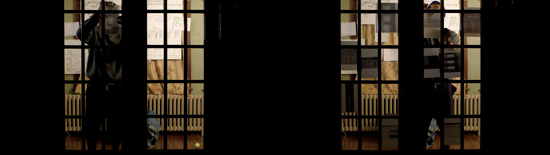
Another type of cut is fade in & out. This is when 2 scenes fade in and out of one another. They are typically used at the start and end of a film as they do not look particularly good in the middle of a film.
One more type of cut is a wipe cut. This is usually used when a scene jumps from one location to another and usually changing characters as it gives a skipping through time kind of effect. (6)
Types of shots (7)
Close up - Close up shots are when the camera is almost kind of in your face, this is used to kind of make something seem important therefore it's made big on screen with either scenery or characters.
Personally I would describe this shot as allowing the audience to know that the image on screen is centre of attention and that there is either a serious situation or a bit of key information about to be announced/acted.
Low angle shot - Low angle shots are when the camera is placed low down to make objects or people look bigger, better or dominant over the thing/person in front/behind them. It definitely has a great effect on the viewers because switching from the low to high shot and use of aggression/assertiveness makes it absolutely perfect.
Aerial shot - An aerial shot is a shot filmed from the air, this is usually to show of amazing scenary/landmarks at the start of a film. It interests the viewer in the beginning of the film by using such fancy camera angles whic hare very professional. Back in the 70's they would've used aircraft such as helicopters to get the high up in the air shots but nowadays we use drones equipped with HD cameras. Aerial shots can also be used in Music videos.
Establishing shot - An establishing shot is a shot that shows where the scene is about to be acted out. It usually comes after an aerial shot and most of the time has appropriate music for that situation playing in the background. The only example I can think for this one would be at the start of Harry Potter films (well some of them) where the cut goes from aerial to establishing the scenery of Hogwarts.
Parallel editing (8)
Parallel editing (also known as Cross cutting) is a technique used by producers to combine/show 2 scenes that happen almost at the same time but are in completely different locations. It was first starting to be noticed after producer Edwin S. Porter used the technique in the 1903 film "The Great Train Robbery". From watching a short extract of a few films where cross cutting is used, I can see it allows the film to build up suspense in the lead up to a scene about to happen. In return this makes the viewers more anxious to know what is going to happen.
The 180 degree rule (9)
The 180 degree rule is a technique used when 2 actors are on set. Producers imagine an invisible line between both actors and make sure that the camera is kept on one side of the line throughout the entire scene. The camera can pass over the line but this means that the 180 degree has been broken and the audience will get confused because the characters now look like they have switched sides with one another making it seem as if they have changed clothes & appearance in a matter of seconds.

1, 2, 3) Bibliography:
Cinematograph (2016) in Wikipedia. Available at: https://en.wikipedia.org/wiki/Cinematograph.In-line Citation:(Cinematograph, 2016)


4) Bibliography:
Auguste and Louis Lumière (no date) in Wikipedia. Available at: https://en.wikipedia.org/wiki/Auguste_and_Louis_Lumi%C3%A8re.In-line Citation:(Auguste and Louis Lumière, no date)

5) Bibliography:
6) Bibliography:
Hockrow, R. (2014) Peachpit. Available at: http://www.peachpit.com/articles/article.aspx?p=2233986&seqNum=4.In-line Citation:(Hockrow, 2014)
7) Bibliography:
Freer, I. and Gibbs, O. (2013) Film studies 101: The 30 camera shots every film fan needs to know. Available at: http://www.empireonline.com/movies/features/film-studies-101-camera-shots-styles/.In-line Citation:(Freer and Gibbs, 2013)8) Bibliography:
Moura, G. (2014) ‘Elements of cinema’, Elements of Cinema, 1 July. Available at: http://www.elementsofcinema.com/editing/parallel-editing/.In-line Citation:(Moura, 2014)

9) Bibliography:
Bibliography:Marcelo Paulo De Souza (2011) Film studies: 180° degree rule. Available at: https://www.youtube.com/watch?v=y4wX_dmh8_g.In-line Citation:(Marcelo Paulo De Souza, 2011)
Subscribe to:
Posts (Atom)