Extracting Information From Written Sources
History of film editing
Film editing was first pioneered by the Lumiere Brothers in 1895(1). They invented the cinematographe, and early film camera and projector. The device is specifically called the "Cinematographe Leon Bouly" however the original creator was called Leon Bouly but due to him not being able to afford the patent fees he sold up the name and rights to the Lumiere Brothers. The first film to be shot using the Cinematographe was "La Sortie de l'usine Lumiere a Lyon"(2). The film features employees leaving the Lumiere Factory in large groups into the streets of Lyon. The film was shot by the Lumiere Brothers which also went on to film short videos including La Voltige & Peche aux poissons rouges.
In December 1895 they released their invention to the public and also had a few showings for films. A lot of people attended this event as they were either inspired by the idea of capturing video using cameras or genuinely excited. One man really stood out from the rest of the people because he actually tried to purchase the device from the Lumiere Brothers for a large amount of money. (3) After the person spoke with the Lumiere Brothers his attempt to purchase the device was unsuccessful as they did not want other people to make money from the device just yet. The Cinematographe worked by strolling through a large amount of photos every second to create a smooth video like stop-motion styled video. (4)
One of the first videos ever made using the device was a short film which shows a man with a 'garden hose' watering what looks like to be some plants, and along comes someone from behind and they begin to stand on the pipe in order to stop the flow of water making the other man look directly into the end of the pipe wondering what was going on with it. The person then quickly steps of, of the pipe making the water splash directly into the persons face. This video was made for comedic reasons. (5)
Types of cuts
One type of cut is a Jump Cut. It involves 2 frames that are very similar but suddenly change to something happening later on in that scene. They can be used as a way to either pass time or to show repetitiveness in a cut. For example in the following photo it shows a person standing in a window and then all of a sudden cuts to him standing on the other side of the window.

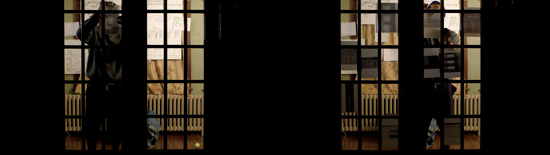
Another type of cut is fade in & out. This is when 2 scenes fade in and out of one another. They are typically used at the start and end of a film as they do not look particularly good in the middle of a film.
One more type of cut is a wipe cut. This is usually used when a scene jumps from one location to another and usually changing characters as it gives a skipping through time kind of effect. (6)
Types of shots (7)
Close up - Close up shots are when the camera is almost kind of in your face, this is used to kind of make something seem important therefore it's made big on screen with either scenery or characters.
Personally I would describe this shot as allowing the audience to know that the image on screen is centre of attention and that there is either a serious situation or a bit of key information about to be announced/acted.
Low angle shot - Low angle shots are when the camera is placed low down to make objects or people look bigger, better or dominant over the thing/person in front/behind them. It definitely has a great effect on the viewers because switching from the low to high shot and use of aggression/assertiveness makes it absolutely perfect.
Aerial shot - An aerial shot is a shot filmed from the air, this is usually to show of amazing scenary/landmarks at the start of a film. It interests the viewer in the beginning of the film by using such fancy camera angles whic hare very professional. Back in the 70's they would've used aircraft such as helicopters to get the high up in the air shots but nowadays we use drones equipped with HD cameras. Aerial shots can also be used in Music videos.
Establishing shot - An establishing shot is a shot that shows where the scene is about to be acted out. It usually comes after an aerial shot and most of the time has appropriate music for that situation playing in the background. The only example I can think for this one would be at the start of Harry Potter films (well some of them) where the cut goes from aerial to establishing the scenery of Hogwarts.
Parallel editing (8)
Parallel editing (also known as Cross cutting) is a technique used by producers to combine/show 2 scenes that happen almost at the same time but are in completely different locations. It was first starting to be noticed after producer Edwin S. Porter used the technique in the 1903 film "The Great Train Robbery". From watching a short extract of a few films where cross cutting is used, I can see it allows the film to build up suspense in the lead up to a scene about to happen. In return this makes the viewers more anxious to know what is going to happen.
The 180 degree rule (9)
The 180 degree rule is a technique used when 2 actors are on set. Producers imagine an invisible line between both actors and make sure that the camera is kept on one side of the line throughout the entire scene. The camera can pass over the line but this means that the 180 degree has been broken and the audience will get confused because the characters now look like they have switched sides with one another making it seem as if they have changed clothes & appearance in a matter of seconds.

1, 2, 3) Bibliography:
Cinematograph (2016) in Wikipedia. Available at: https://en.wikipedia.org/wiki/Cinematograph.In-line Citation:(Cinematograph, 2016)


4) Bibliography:
Auguste and Louis Lumière (no date) in Wikipedia. Available at: https://en.wikipedia.org/wiki/Auguste_and_Louis_Lumi%C3%A8re.In-line Citation:(Auguste and Louis Lumière, no date)

5) Bibliography:
6) Bibliography:
Hockrow, R. (2014) Peachpit. Available at: http://www.peachpit.com/articles/article.aspx?p=2233986&seqNum=4.In-line Citation:(Hockrow, 2014)
7) Bibliography:
Freer, I. and Gibbs, O. (2013) Film studies 101: The 30 camera shots every film fan needs to know. Available at: http://www.empireonline.com/movies/features/film-studies-101-camera-shots-styles/.In-line Citation:(Freer and Gibbs, 2013)8) Bibliography:
Moura, G. (2014) ‘Elements of cinema’, Elements of Cinema, 1 July. Available at: http://www.elementsofcinema.com/editing/parallel-editing/.In-line Citation:(Moura, 2014)

9) Bibliography:
Bibliography:Marcelo Paulo De Souza (2011) Film studies: 180° degree rule. Available at: https://www.youtube.com/watch?v=y4wX_dmh8_g.In-line Citation:(Marcelo Paulo De Souza, 2011)
